We use analytics to improve the site. Privacy
How AI search engines are transforming SEO and how businesses need to adapt.
With the arrival of Google AI Overviews, Bing Chat, Perplexity and other answer engines, one question keeps coming back: does SEO still make sense?
The short answer: more than ever. AI search engines don't replace SEO. Instead, they make it more demanding. Mediocre content, pages optimized only for keywords and artificial techniques lose effectiveness. Clear, structured and genuinely useful content gains visibility.
60%
of Google searches end without a click in 2025, a trend amplified by AI Overviews
SparkToro / Datos, 2025
Key takeaway
AI engines don't kill SEO, they eliminate mediocre content. Businesses that adapt now gain a significant head start.
Google AI Overviews, Perplexity or ChatGPT Search don't just list web pages. They analyze content, extract relevant information and formulate a synthetic response. This shift has given rise to two concepts: GEO (Generative Engine Optimization), which focuses on optimizing for generative AI engines, and AEO (Answer Engine Optimization), which targets direct-answer search engines.
For a site to be cited in these responses, it must be structurally clear. AI engines favor content that directly answers a question, with logical hierarchy (headings, subheadings, lists) and verifiable information.
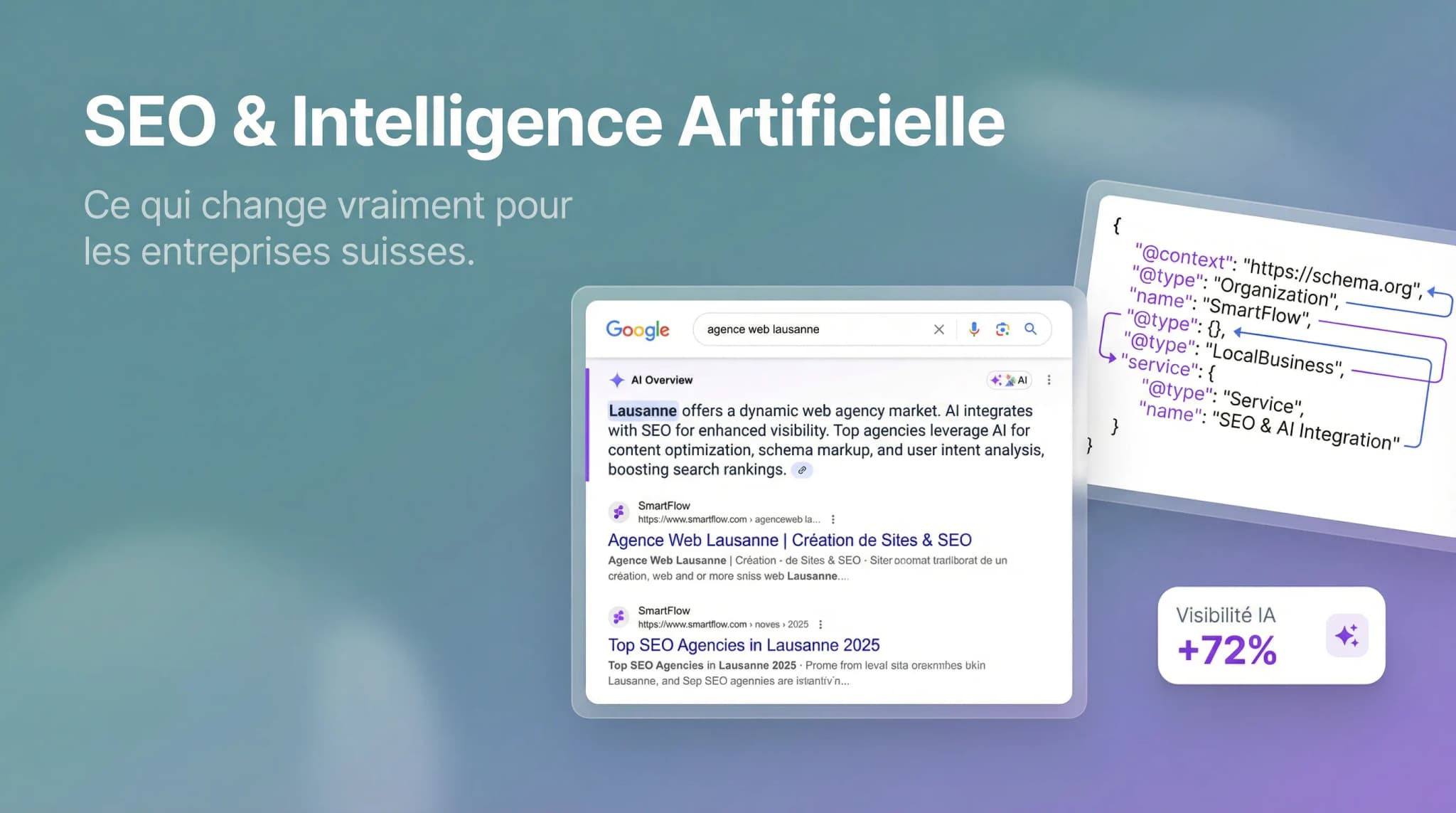
Structured data (Schema.org) plays a growing role. It allows engines to precisely understand what a page contains: a service, a price, a FAQ, a review, a person. The more machine-readable your site is, the more likely it is to appear in AI responses.
Organic traffic isn't disappearing, but it's redistributing. Simple informational queries (definitions, lists, basic comparisons) are increasingly handled directly in results, without a click to a website.
However, high-intent queries, those leading to a purchase, a contact or a decision, still generate traffic. And sites cited as sources in AI responses benefit from increased visibility and reinforced credibility.
“The challenge is no longer just appearing in results, but being the source that AI chooses to cite.”
A Semrush study shows that content cited in AI Overviews shares common characteristics: clear structure (H2/H3), direct answers to questions, and demonstrated topical authority.
— Semrush · semrush.com
Structure content with clear headings and logical hierarchy. AI engines scan structure before reading content.
Answer questions directly. If your page targets the query 'how much does a website cost in Switzerland', the answer should be visible and explicit, not buried in an introductory paragraph.
Use structured data (JSON-LD). FAQ, services, reviews, local information. Each markup helps engines understand your content.
Produce original, expert content. AI favors content that brings a unique perspective, concrete data or verifiable expertise. Generic copy-paste content has never had less value.
Create an llms.txt file at the root of your website. This file helps AI models understand your site's structure and content, increasing your chances of being cited in generated answers.
Optimize technical performance. A fast, accessible and well-structured site remains a fundamental prerequisite, AI or not.
We integrate these evolutions into every project. Our sites are built with comprehensive structured data (Organization, Service, FAQ, HowTo, BreadcrumbList), a llms.txt file for AI crawlers, and a content architecture designed for semantic understanding.
The SEO we practice isn't a keyword race. It's work on clarity, structure and quality that benefits human visitors as much as search engines, whether classic or AI-powered.
More than ever. AI search engines (Google AI Overviews, Perplexity, Bing Chat) extract their answers from well-referenced web pages. Without solid SEO, your site will not be cited by AI engines.
GEO refers to optimising your content to be selected and cited by generative AI engines. It involves structured data, clear expertise signals, concrete information and content that directly answers user questions.
AEO involves structuring your content to appear directly in AI-generated answers: Google AI Overviews, Bing Chat, Perplexity. FAQ sections with structured data (FAQPage schema) are a key AEO lever.
Structure your content with clear questions and concise answers. Use FAQ sections, structured data (JSON-LD), factual information and authoritative sources. Google favours content that directly and precisely answers user queries.
Yes. Structured data (Schema.org JSON-LD) help Google understand your content, your services and your location. For a Swiss business, LocalBusiness and FAQPage schemas significantly improve local visibility.
No. The fundamentals remain: quality content, solid technical foundation, clear structure, authoritative signals. What changes is the format: content must be more structured, more factual and more directly answerable.
Go deeper on search visibility
Explore our SEO approach to structure content strategy, internal linking and technical optimizations.
View our SEO pageEvery collaboration starts with a conversation. Tell us about your project, we'll get back to you within 48h.