Nous utilisons des analytics pour améliorer le site. Confidentialité
Avantages, limites et cas d'usage de chaque approche pour faire un choix éclairé selon votre projet en Suisse.
Site sur mesure ou WordPress ? C'est l'une des premières questions que se posent les entreprises à Lausanne et en Suisse romande quand elles envisagent de créer ou refaire leur site web. Et c'est une question légitime : le choix de la technologie conditionne la performance, la durabilité et le potentiel de votre présence en ligne.
43 %
des sites dans le monde utilisent WordPress en 2025
W3Techs, 2025
WordPress propulse environ 40 % des sites web dans le monde. C'est un outil puissant, flexible, avec un écosystème immense. Dire le contraire serait malhonnête. De l'autre côté, les sites développés en code (avec des frameworks comme Next.js, React ou Vue) offrent un niveau de contrôle, de performance et de personnalisation que WordPress ne peut pas atteindre dans sa logique standard.
Le bon choix dépend de votre projet, pas d'une préférence technologique. Voici comment y voir clair.
WordPress est pertinent quand vous avez besoin de publier régulièrement du contenu (blog, actualités) et que vous souhaitez le faire vous-même sans toucher au code. Son interface d'administration est accessible et bien connue.
Il est aussi adapté aux projets à budget limité où la priorité est d'être en ligne rapidement, sans exigence particulière en termes de performance ou de design.
Avec les bons plugins et un thème bien construit, WordPress peut produire un résultat tout à fait correct pour un site simple. De nombreuses petites structures en Suisse l'utilisent avec succès pour des projets basiques.
La dépendance aux plugins est le point faible principal. Chaque plugin ajouté est une couche de code supplémentaire, souvent développée par un tiers, qu'il faut maintenir et mettre à jour. Les conflits entre plugins sont fréquents, et les failles de sécurité aussi.
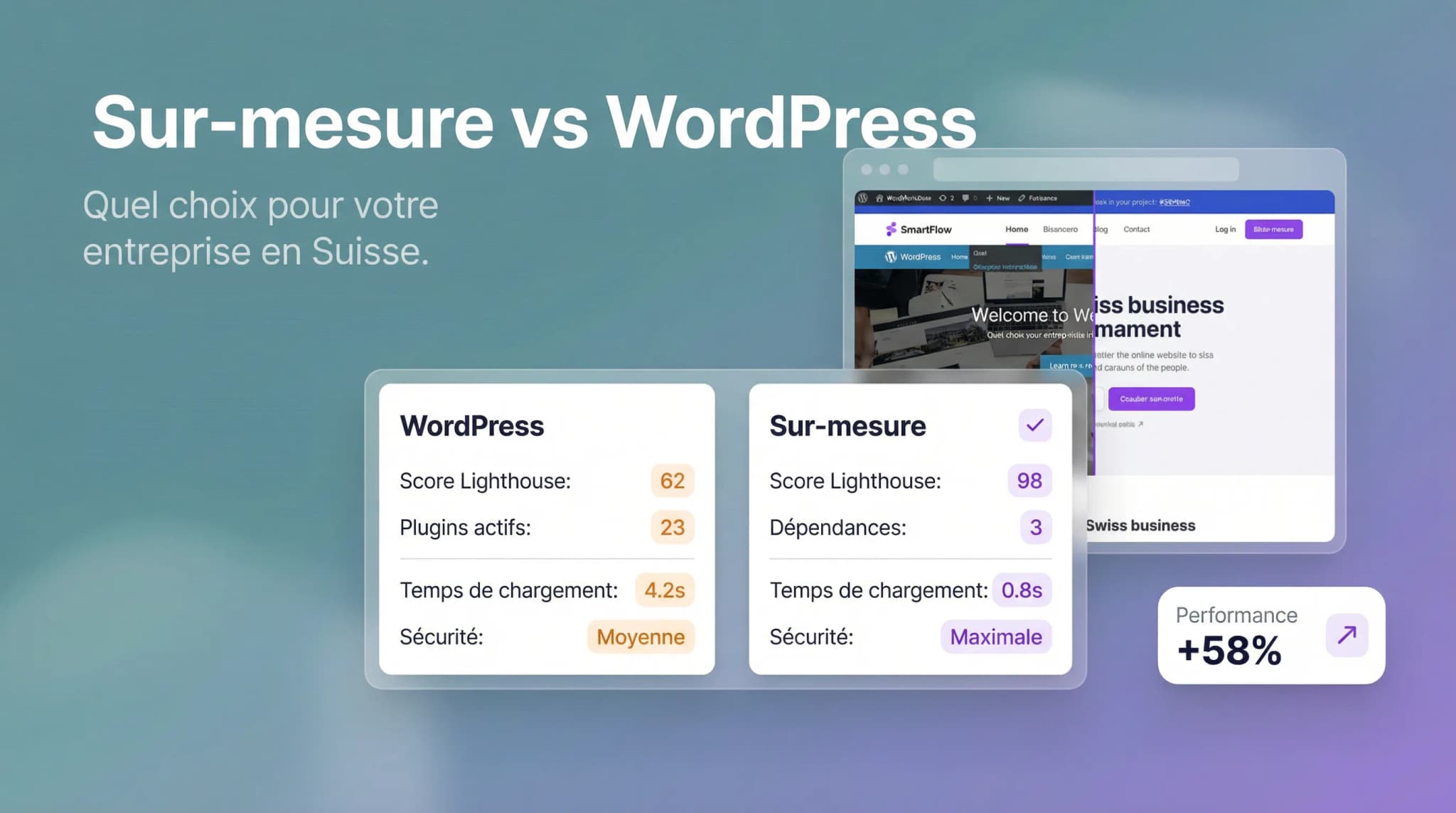
Les performances sont un autre sujet. Un site WordPress standard, avec 10 à 15 plugins actifs, est rarement capable d'atteindre un score Lighthouse supérieur à 70-80. Un site codé en Next.js, avec la même richesse de contenu, dépasse régulièrement les 95.
Le design est contraint par le thème choisi. Même avec un page builder, les possibilités restent limitées par la structure du thème. Le résultat est souvent un compromis entre ce que vous voulez et ce que le thème permet.
Attention aux plugins
Chaque plugin WordPress ajoute du code tiers non audité, augmente la surface d'attaque et ralentit le site. En 2024, 97 % des vulnérabilités WordPress provenaient de plugins et thèmes tiers.
Enfin, WordPress génère un poids de page important (CSS et JavaScript chargés pour des fonctionnalités non utilisées), ce qui impacte directement le temps de chargement et le référencement, un handicap concret pour les entreprises suisses qui veulent être visibles sur Google.
Un site sur mesure est construit spécifiquement pour votre projet. Il n'y a pas de code inutile, pas de plugins tiers, pas de contraintes de thème.
Chaque page est pensée pour votre contenu, vos parcours utilisateur et vos objectifs. Le design n'est pas une adaptation d'un modèle existant, c'est une création originale.
| Critère | WordPress | Sur-mesure |
|---|---|---|
| Temps de chargement | 2 – 5 s | < 1 s |
| Sécurité | Plugins = surface d'attaque | Code audité, zéro dépendance inutile |
| SEO technique | Correct avec plugins | Optimal natif |
| Scalabilité | Limitée | Illimitée |
| Coût de migration | Élevé (dette technique) | Faible (architecture propre) |
Les technologies modernes (Next.js, React, TypeScript) permettent un rendu serveur optimisé, un chargement quasi instantané, et une flexibilité totale pour faire évoluer le site dans le temps.
Le SEO est intégré dès la conception : balisage sémantique propre, données structurées, Core Web Vitals optimisés, pas de surcharge technique. Pour les entreprises à Lausanne qui veulent se positionner sur Google, cette rigueur technique fait une différence mesurable.
Chez SmartFlow, agence web à Lausanne, nous développons en code. Ce n'est pas un choix dogmatique. C'est un choix de cohérence avec ce que nous promettons à nos clients en Suisse romande : des sites performants, durables et parfaitement adaptés à leur activité.
Si votre projet se résume à un blog personnel ou à une vitrine très simple sans ambition de visibilité, WordPress peut suffire. Pour tout le reste (site d'entreprise, projet à forte valeur ajoutée, volonté de se démarquer), le sur-mesure apporte une différence mesurable.
La question n'est pas quel outil est le meilleur dans l'absolu, mais quel outil est le plus adapté à ce que vous cherchez à accomplir.
WordPress reste un bon choix pour des projets simples : blog, site vitrine basique avec publication fréquente. Mais pour une PME qui veut performer sur Google et offrir une expérience utilisateur premium, le développement sur mesure est plus adapté.
Un site WordPress standard atteint généralement un score Lighthouse de 60 à 80. Un site développé sur mesure en Next.js dépasse régulièrement les 95. Cette différence se traduit directement par un meilleur référencement et un taux de rebond plus faible.
À l'achat, oui : un site sur mesure démarre autour de 3'000 CHF contre quelques centaines pour WordPress. Mais sur 3 à 5 ans, le coût total (maintenance, mises à jour, corrections, refonte) est souvent comparable. Le site sur mesure offre en plus de meilleures performances et un référencement supérieur.
Oui. La migration demande un travail de restructuration du contenu et de mise en place des redirections SEO, mais le résultat justifie l'investissement. Chez SmartFlow, nous accompagnons les entreprises à Lausanne dans ce type de transition.
Parce que c'est plus rapide à mettre en place et que beaucoup d'agences ne développent pas en code. Le choix technique dépend de la capacité du prestataire autant que des besoins du client.
Approfondir ton projet de site web
Consulte notre page création de sites pour voir les offres, les étapes projet et les options de refonte.
Voir notre page création de sitesOn commence toujours par un échange. Racontez-nous votre projet, on vous répond sous 48h.