We use analytics to improve the site. Privacy
A clear, actionable framework to define your website project, align budget and timeline, and choose the right agency without grey areas.
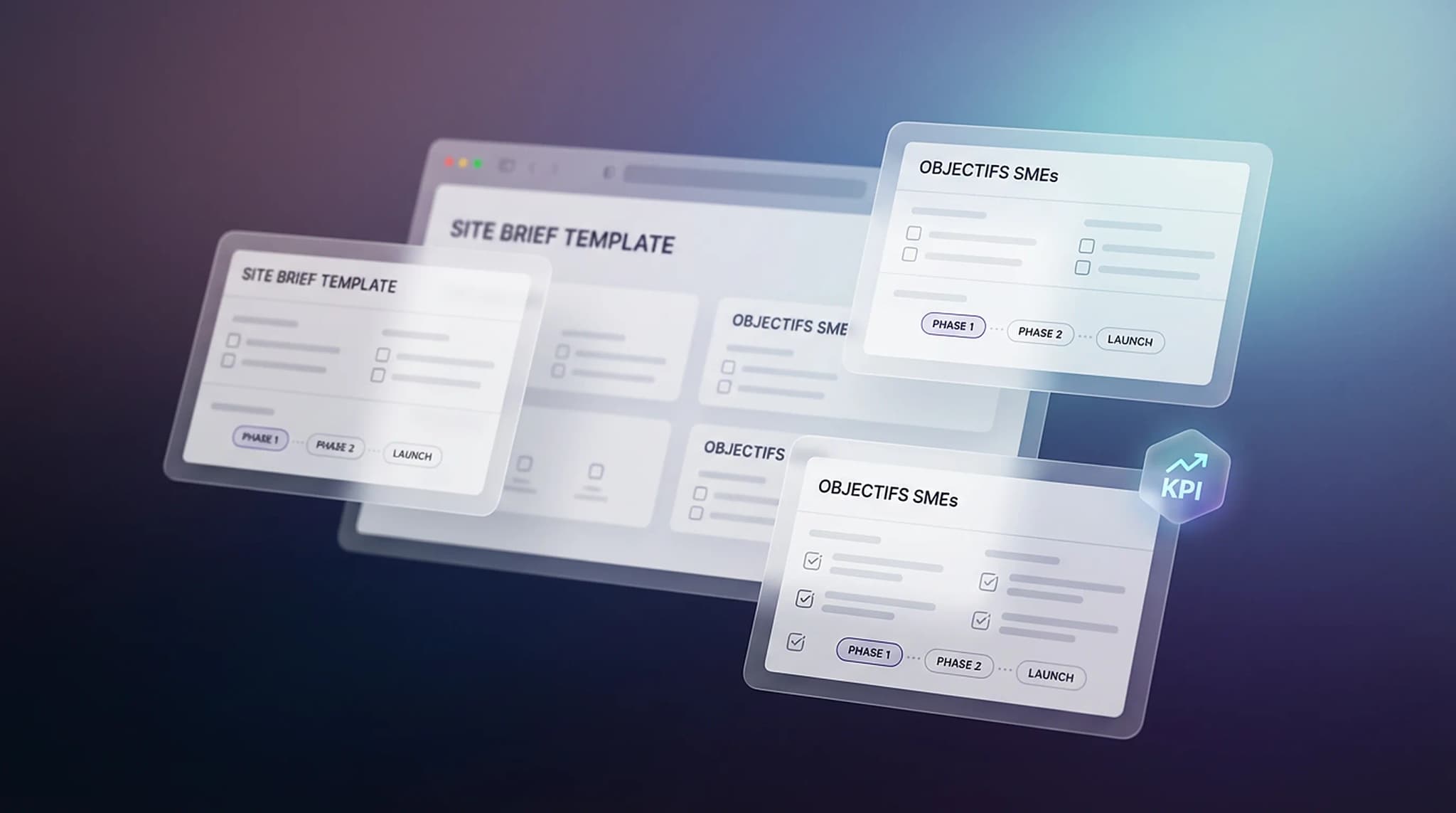
Many web projects fail before the first mockup. Not because of budget, but because of unclear scope. When needs are not defined precisely, every decision becomes ambiguous, and the project drifts in cost, timeline and quality.
A strong brief is not an administrative document. It's a strategic tool that aligns your team, your agency and your business goals. It turns a vague intention, 'we need a new website', into an executable plan.
For an SME in Western Switzerland, this matters even more: decision cycles are short, resources are limited, and every investment must produce a measurable return. Good scoping protects both your time and your money.
The rule is simple: the clearer the framework upfront, the less you pay for surprises later.
1) Company context and business objective. Who are you, which market do you serve, and what concrete problem must the new website solve? Generate qualified leads, recruit talent, improve credibility, sell online: the primary objective must be singular and measurable.
Context and objectives
Describe your company, market, business goals and what the site must concretely achieve.
Target audience and user journeys
Identify your personas, their needs and the main journeys they will take on the site.
Site map and content
List the required pages, navigation hierarchy and content to produce or migrate.
Technical constraints and budget
Specify required technologies, third-party integrations, available budget and desired timeline.
2) Target audiences and user journeys. Define 2 to 3 priority profiles (for example: SME owner, marketing manager, technical buyer) and the actions each should take on the site. Without target journeys, conversion cannot be optimized.
3) Value proposition and key messages. What you do, for whom, and why you are different. If this is unclear in the brief, it will be unclear on the website.
4) Functional scope. List expected pages, features and integrations: blog, forms, CRM, booking, FR/EN multilingual support, analytics tracking, and so on. Separate must-have from nice-to-have.
5) Design and content requirements. Visual references, expected premium level, editorial tone, existing content to reuse, new content to produce. Premium websites cannot be directed with vague instructions.
6) Technical and SEO requirements. Performance (Core Web Vitals), security, CMS vs custom stack, SEO structure, structured data, redirects, accessibility. This section prevents late technical compromises.
7) Budget framework. Provide a realistic range rather than an arbitrary fixed number. A competent agency can advise better when constraints are explicit.
8) Project governance. Who decides, who validates, who provides content, who coordinates internally. Fuzzy governance is one of the main causes of delay.
9) Timeline and success metrics. Target go-live date, milestones, and post-launch KPIs (leads, qualified traffic, conversion rate, local visibility).
On budget, the classic mistake is asking for 'a quote' without defining expected quality. Result: you compare proposals that are not comparable. In Lausanne, two offers at the same price can produce completely different outcomes.
On timeline, include realistic buffer for approvals and content production. In most SME projects, the bottleneck is not development, it's waiting for internal validation and missing inputs.
On responsibilities, define ownership from day one. Example: agency handles design, development and technical SEO; company validates mockups within 72 hours and provides business inputs. When rules are explicit, execution stays smooth.
Good scoping does not reduce flexibility, it protects the project from expensive improvisation.
Primary objective: generate 15 qualified inbound enquiries per month from Lausanne and Western Switzerland.
Target audience: SME leaders (10-100 employees) in B2B services, sensitive to quality and return on investment.
MVP scope: homepage, services, about, case studies, blog, contact; CRM-connected form; GA4 + Search Console tracking; FR first, EN second.
Even a 2-page brief is better than nothing. The key is to formalize your expectations in writing so the agency can provide an accurate quote and avoid misunderstandings.
Constraints: premium brand perception, excellent mobile performance, local SEO architecture, go-live within 10 weeks.
6-month KPI targets: +40% qualified organic traffic, 3 local keywords in top 10, form conversion rate >= 2.5%.
Your main business objective is written in one sentence with a measurable indicator.
Final checklist before sending
Your priority audiences are defined with concrete needs and objections.
The scope is prioritized: must-have, important, optional.
Expected quality level (design, technical, SEO) is explicit.
Budget is defined as a realistic range, not an arbitrary number.
Internal validation roles are assigned by name.
Timeline includes margin for content and feedback cycles.
Post-launch KPIs are clear and trackable.
Yes. Even for a 5-to-8-page site, it prevents misunderstandings about scope, quality and timeline. The smaller the project, the more each mistake costs proportionally.
There is no ideal length. For most SMEs, 4 to 10 well-structured pages are enough. Clarity and relevance matter more than volume.
Not necessarily, but you need at least a defined structure, key messages and clear ownership for content production. No content plan is one of the first causes of delays.
Yes, but changes must be prioritized and arbitrated. A solid brief is the reference point that helps decide what belongs to phase 1 and what moves to phase 2.
The brief describes your business need. The agency proposal responds with a method, budget and schedule. Without a clear brief, the proposal remains partial.
Yes. We provide a strategic scoping phase to clarify goals, scope, architecture and SEO priorities before production starts. It reduces risk and accelerates execution.
Go deeper on website delivery
Explore our website creation page to review project scope, delivery steps and redesign options.
View our website creation pageEvery collaboration starts with a conversation. Tell us about your project, we'll get back to you within 48h.