We use analytics to improve the site. Privacy
A practical method to measure website profitability for SMEs in Lausanne: qualified leads, cost per opportunity, break-even logic, and a 90-day action plan.
Many SMEs in Western Switzerland still manage their website with surface metrics: traffic, clicks, impressions. Useful signals, but they do not tell you whether the website creates business value.
The right layer is business performance: how many qualified leads are generated, how many become opportunities, and how many turn into signed customers. Without this chain, budget decisions remain approximate.
In Lausanne, where local competition is strong on high-intent queries, visibility alone is not enough. What matters is real channel profitability over 6 to 12 months.
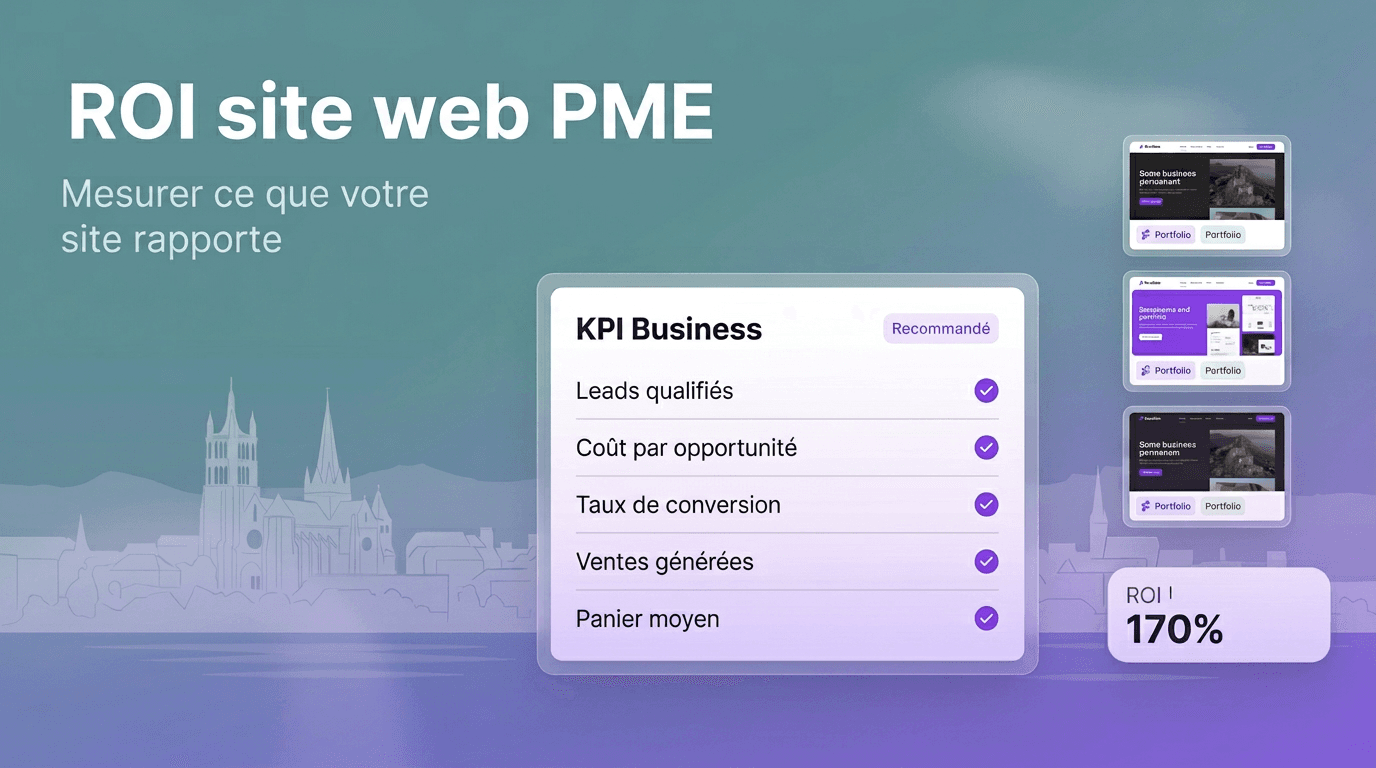
1) Qualified leads per month: contacts that match your target profile and average deal size, not just any form submission.
2) Lead-to-opportunity rate: it reflects both traffic quality and value proposition clarity.
5.3x
Average ROI of a professional website for a local SME over 3 years
SmartFlow benchmark, 2025
3) Cost per opportunity (CPO): the key metric to compare your website against other acquisition channels.
4) Gross margin generated by website-originated customers: ROI should be calculated on margin, not only top-line revenue.
Useful definition
Website ROI = (gross margin generated by the website - total website cost) / total website cost. This formula helps you decide quickly whether your website is a cost center or a profitable asset.
Step 1: calculate total annual website cost. Include build or redesign amortization, maintenance, content production, SEO, and measurement tools.
Step 2: measure your monthly commercial flow from the website: qualified leads, opportunities, signed customers. Define each stage clearly.
Step 3: estimate average margin per customer. For B2B service SMEs, a 35% to 60% range is common depending on business model.
Step 4: project over 12 months. The first two months are often about data quality, then performance improves with SEO and conversion optimization.
Decision rule
If cost per opportunity decreases for 3 consecutive months and your opportunity-to-customer rate stays stable or improves, your trajectory is healthy.
Assumption: total annual website cost (amortized redesign + maintenance + operational SEO) = CHF 24,000.
Yearly flow: 180 qualified leads, 54 opportunities (30%), 16 signed customers (30%), average deal value CHF 9,000, gross margin 45%.
Yearly gross margin generated by the website: 16 x 9,000 x 45% = CHF 64,800.
Yearly ROI: (64,800 - 24,000) / 24,000 = 1.7, or 170%. In this scenario, the website is not only sustainable, it becomes a growth lever.
“A high-performing website is not judged by the noise it makes, but by the margin it generates.”
Mistake 1: confusing traffic volume with business quality. Broad but low-intent traffic can hurt conversion.
Mistake 2: not connecting analytics and CRM. Without a full loop, attribution stays incomplete.
Google Analytics 4 lets you track conversions with multi-touch attribution. Set up conversion events for each key action (form, call, email) to measure your site’s true return.
— Google Analytics · analytics.google.com
Mistake 3: changing too many variables at once. You lose the ability to identify what actually drives improvement.
Days 1 to 30: define KPI logic, clean tracking setup (GA4, Search Console, form events), and align CRM statuses.
Days 1-30: Set up tracking
Configure GA4, Search Console and conversion tracking. Define your 3 main KPIs.
Days 31-60: First review
Analyze the first month’s data. Identify high-potential pages and friction points in the conversion path.
Days 61-90: Optimize and iterate
Launch your first data-driven optimizations: improve key pages, adjust CTAs, strengthen SEO content.
Days 31 to 60: optimize high-intent pages (services, contact, local pages), clarify CTAs, and reduce form friction.
Days 61 to 90: run a monthly executive review with 4 numbers: qualified leads, CPO, opportunity-to-customer rate, generated margin.
Realistic objective
In 90 days, the goal is not a traffic miracle. The goal is a reliable steering system to make better budget decisions.
Recommended internal linking
To go further: /creation-sites, /seo, /blog/cout-site-web-suisse.
There is no universal threshold, but a stable positive ROI over 12 months is the minimum target. For B2B service SMEs, aiming for 50% to 150% over 12 to 18 months is realistic with solid tracking and a clear conversion path.
In practice, 3 to 6 months provides a first actionable reading, then 9 to 12 months gives a structural performance view. The first two months are mostly about reducing measurement bias.
Ideally yes. Without CRM, you can track leads but not full progression to opportunities and signed customers. ROI remains partial and less useful for decisions.
No. Traffic is an activity metric, not a profitability metric. It must be tied to opportunities, close rates, and margin.
Use cost per opportunity and net margin by channel over the same period. Websites are often slower initially but can be more profitable over time due to compounding SEO effects.
Audit the full chain: traffic quality, value proposition clarity, form friction, mobile speed, and lead handling by sales. Negative ROI usually comes from one weak link that can be identified and fixed.
Go deeper on website delivery
Explore our website creation page to review project scope, delivery steps and redesign options.
View our website creation pageEvery collaboration starts with a conversation. Tell us about your project, we'll get back to you within 48h.